
2026 World Cup Quarter-Final Match Analysis, Odds & Predictions
The 2026 World Cup has reached one of the most intense stages of the tournament: the Quarter-Finals, or the last-8 round. This is the point where every remaining team has already proven their quality in terms of player talent, tactical organisation, and mental resilience in knockout football. After a fiercely contested Round of 16, there is no such thing as an "easy" game from here on, because even the smallest mistake can change the path to the semi-finals in an instant.
The 4 must-watch ties in this round are: France vs Morocco, Spain vs Belgium, England vs Norway, and Argentina vs Switzerland. Each match has a distinctly different appeal. Some pit the favourites against a defensively solid underdog, others showcase technical football against high-experience sides, while certain ties could turn into dramatic encounters, as the playing styles of both teams are capable of causing problems for each other across the full 90 minutes.
What makes this round more fascinating than the previous ones is that teams are beginning to reveal more of their tactical cards. Coaches must decide whether to play conservatively or adopt an attacking approach, whether to take risks from the start or wait for counter-attacking opportunities, and how to manage player energy as the fixture schedule intensifies. This is the round that tests not just a team's reputation, but also game details, composure in the final third, and each player's ability to handle pressure.
This article provides an in-depth 2026 World Cup match analysis for the Quarter-Finals, exploring the strengths of each tie, which side holds the tactical advantage, and which factors could prove decisive in determining who advances to the semi-finals.
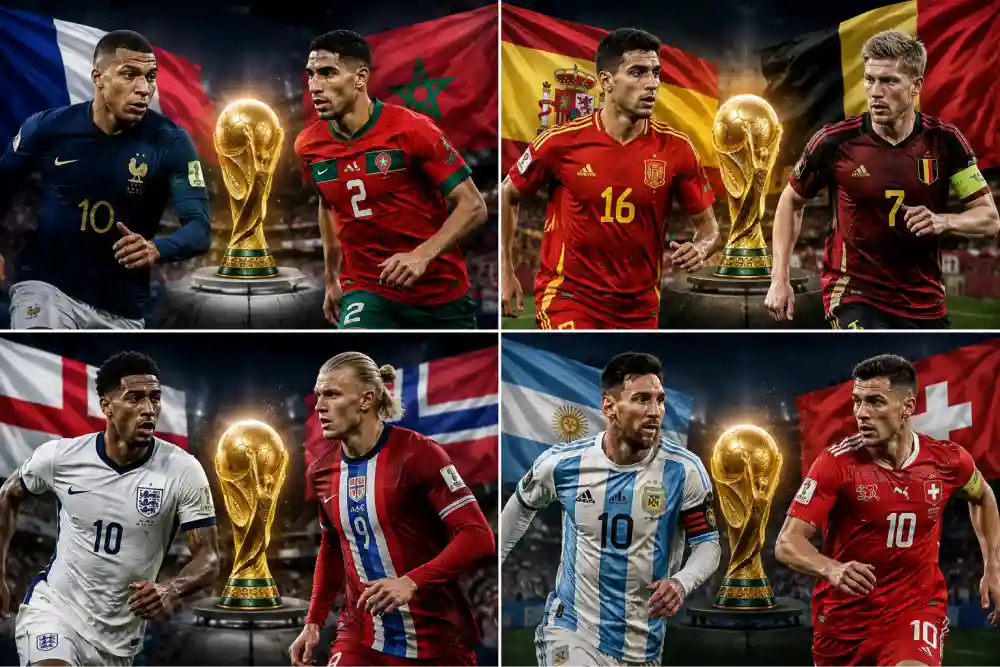
The quarter-finals are full of exciting matches you absolutely can't miss
2026 World Cup Quarter-Final Overview: Why All 4 Ties Are Worth Watching
The Quarter-Finals mark the point where the World Cup shifts from being a competition of "teams in good form" to a battle of "teams ready to be champions." With only 8 teams remaining, every nation still in the running has more than enough quality to cause problems for their opponents. The favourites can no longer afford to play complacently, while the underdogs no longer step onto the pitch feeling as inferior as they might have in the earlier rounds, because reaching this stage naturally builds immense confidence throughout the squad.
The overall picture of these 4 ties is highly varied. France take on Morocco, a side with a rock-solid defence and a clear understanding of how to play against top teams. Spain must contend with Belgium, who may not dominate possession but possess match-winners capable of changing the game from a single moment. England vs Norway is a particularly intriguing fixture, as England are well-rounded but face a team with blistering pace and a world-class striker. Meanwhile, Argentina vs Switzerland sees the world champions up against a disciplined side that is extremely difficult to score against.
This round is also where small details gain significantly more weight, such as team selection, substitutions in the second half, set-piece management, and even emotional control, because matches at this level are rarely decided by multiple goals, but rather by a few crucial moments. The team with greater concentration and sharper finishing will immediately gain the upper hand.
The Quarter-Final is the stage that tests tactics, experience, and the composure of the favourites
What makes the Quarter-Finals particularly intense is that every team has a clear strength. The favourites may have superior individual quality, but well-organised underdogs can make the game uncomfortable and force their opponents into uncharacteristic errors. If the match drags on into the later stages, composure, experience, and the coach's ability to adapt become even more important than pre-match statistics or reputation.
2026 World Cup Match Analysis: France vs Morocco – Solid Defence Meets Title Favourites
The tie between France and Morocco is one of the most tactically intriguing matches of the Quarter-Finals, as it pits a team with a complete attacking arsenal against a side renowned for defensive discipline. France remain one of the favourites to lift the trophy, boasting deep squad depth, pace in attack, and the ability to score through multiple channels, whether via wide play, central penetration, or set pieces.
On the other hand, Morocco are not an easy side to break down. They have a very organised defensive system, with every player understanding their role and covering space diligently. Their key strength lies in not allowing opponents to operate freely in dangerous areas, and when they win the ball back, they can transition quickly into counter-attacks. If France dominate possession but fail to find a breakthrough, this could become a much more uncomfortable match than many anticipate.
The heart of the game is likely to be in midfield. If France can control the tempo and pull Morocco out of shape, they will create more space for their attackers. However, if Morocco disrupt play and force France to release the ball too quickly, their attacking flow may not be as fluid as usual. Another aspect to watch is Morocco's counter-attacking threat, because if France push their defensive line too high, the space in behind could become a dangerous area for Morocco to exploit.
This game is therefore not just about which team has better players, but whether France have the patience to break down Morocco's defence and whether Morocco can maintain their discipline for the full 90 minutes.
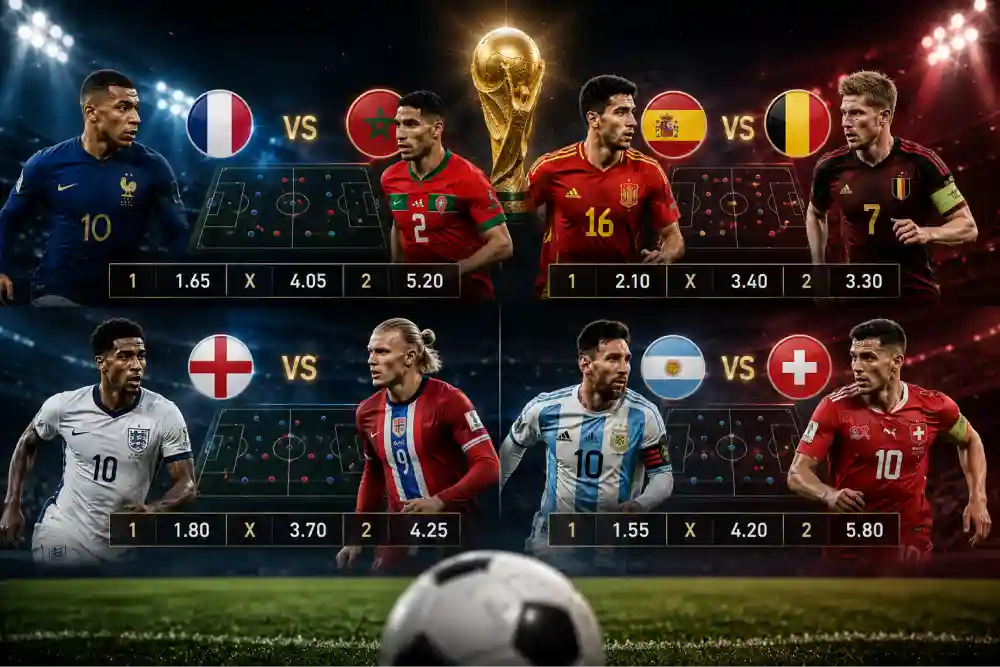
Analyze the match and check the odds at V9BET for accurate betting
Can Morocco stop France's attack? That is the big question in this tie
If Morocco are to have any chance of progressing, they must slow down France's game, limit the space for their attackers, and avoid conceding an early goal, because falling behind would make their defensive plan much harder to execute. But if they can hold out for long periods, the pressure will gradually shift to France, and that could make this tie much more unpredictable than many people think.
Read more: The biggest tactical trends shaping World Cup 2026 and making each match more exciting
2026 World Cup Match Analysis: Spain vs Belgium – Possession Football Meets Clinical Edge
In terms of pure footballing quality, the match between Spain and Belgium is arguably one of the most entertaining ties of the Quarter-Finals. Both teams have world-class players and distinct playing philosophies. Although they build up play differently, both possess more than enough potential to advance to the semi-finals.
Throughout the 2026 World Cup, Spain have continued to demonstrate their trademark possession-based approach. Short passing, movement into space, and game tempo control remain their key strengths, forcing opponents to chase the ball for long periods. However, what makes Spain's football more interesting these days is that they no longer rely solely on possession; they have adopted a more direct attacking style, playing quicker through balls and taking more risks in the final third than in previous tournaments, which has made them noticeably more dangerous in attack.
Belgium, on the other hand, may not dominate possession as much as Spain, but they excel at rapid transitions from defence to attack. Several of their players possess exceptional individual skill, capable of dribbling past defenders or creating chances in tight spaces. They also have a sharp counter-attacking game, which could become a crucial weapon if Spain push their defenders too high up the pitch.
Both teams must be wary of losing possession in midfield, because that is the area where a turnover can turn into a goal within seconds. If Spain give the ball away, Belgium are ready to counter immediately. But if Belgium allow Spain to control the game for too long, they risk being squeezed out of the contest entirely.
Another critical factor is finishing efficiency. At this level, chances are often limited, and the team that converts one or two opportunities into goals will gain a massive advantage, potentially forcing their opponents to open up more in the second half.
If Belgium can withstand Spain's possession game, this tie could be far closer than expected
Although many view Spain as the superior side in terms of system play, Belgium have more than enough quality to cause problems for any team. If they can maintain defensive organisation and execute their counter-attacks with precision, this match could stretch deep into the contest, possibly even requiring extra time to separate the two sides.
England vs Norway and Argentina vs Switzerland – Two Ties That Could Deliver the Most Drama
While these two ties may receive less attention than the France and Spain matches, in terms of competitiveness, they have the potential to deliver excitement throughout the entire game, particularly England vs Norway, which pits two teams with dangerous attacking threats against each other.
England continue to play a balanced style of football, combining quality in midfield, pace on the flanks, and clinical finishing up front, while their defence is also strong and experienced. However, what England must be wary of is Norway's counter-attacking threat. Norway rely on the speed of their attackers and their deadly finishing ability. If England leave too much space, they could concede from a quick transition.
Norway's strength lies in their disciplined approach and rapid attacking transitions when opportunities arise. Their forwards can make the difference through individual brilliance, meaning that even with less possession, they are always capable of scoring.
Another tie not to be overlooked is Argentina vs Switzerland. Many may assume the world champions are clear favourites, but looking at Switzerland's playing style, they are one of the most disciplined teams in the tournament. They are difficult to break down and play a highly organised defensive system.
Argentina continue to rely on team balance as their main strength. Their attack can create chances in multiple ways, while their midfield maintains excellent control of the game. However, if Switzerland can shut down the central areas and force Argentina to play wide throughout the match, this tie may not be as straightforward as many expect.
Both ties are highly likely to be decided by small details, whether it be set pieces, individual errors, or late substitutions, which are common occurrences in knockout football.

Read the analysis, check the odds, and your bets are guaranteed to turn out well
The attacking power of the big teams meets disciplined opponents ready to punish every mistake
What Norway and Switzerland have in common is their discipline and ability to maintain concentration. Both teams are ready to capitalise on a single mistake from their opponents and turn it into a goalscoring opportunity. If England and Argentina fail to convert their superiority into early goals, both matches could become drawn-out, high-pressure affairs that last until the very last minute.
Conclusion
The 2026 World Cup Quarter-Finals represent the stage where the quality between teams becomes tightest. Every nation has already passed significant tests, and with just two more wins needed to reach the final, each match is filled with pressure, precision, and decisions that can change the outcome in a split second.
From our analysis of all 4 ties, whether it be France vs Morocco, Spain vs Belgium, England vs Norway, or Argentina vs Switzerland, each match offers different storylines and factors to follow. Some are decided by attacking play, others by tactical battles, and some require patience throughout the full 90 minutes.
And after reading the analysis from V9BET, it's time to check out the odds in the BTi section on our website and place your bets on the match of your choice. Rest assured, we offer great odds and a wide range of betting markets.
Ultimately, the Quarter-Finals are often the round that creates the most memories for fans, because not only do we get to see top-tier teams battle it out, but it is also the stage where the smallest details can change the course of the entire tournament. Regardless of the final results, all 4 of these matches have the potential to become another classic chapter in the history of the 2026 World Cup.