How to Read Live Champions League Betting Odds on V9Bet
The stronger side has almost continuous possession, the crowd starts applying pressure, and the live betting board keeps shifting with every attacking move. It feels as though a goal is just around the corner. But look more closely: most of the passing is still taking place in front of the defence, while the occasional shot comes from outside the penalty area. This is exactly when players betting live on the Champions League can be most tempted to enter a market, while also facing the greatest risk of paying the price for confusing possession with genuine scoring potential.
Reading V9Bet Champions League live odds is not a race to click faster than everyone else. The real value lies in reading three layers of information at the same time: what kind of game is unfolding, how much of that information the market has already priced into the odds, and whether the stake still fits within the remaining bankroll. SABA, BTi and IM may present betting boards differently, but the principles for assessing the rhythm of a match remain the same.
Sometimes the most reasonable decision is to wait another five minutes. At other times, it may be better to skip the match entirely, even when the team you are following is applying heavy pressure. A live bet is only worth considering when the on-field action, odds movement and price are telling a reasonably consistent story. If any of the three contradicts the others, staying out can still be a valid choice.
Key Takeaways
- Pressure does not automatically mean a goal is coming. Separate possession from the quality of chances and the ability to penetrate the penalty area.
- Odds movements show that the market is repricing the match, but they do not automatically prove that a particular selection offers an advantage.
- When reading C1 live betting movements, start with the scoreline, time remaining, team formations and how urgently each side needs a goal.
- SABA, BTi and IM should be chosen based on how clearly you can observe the market, how quickly you can operate it, and which markets you genuinely understand. Do not open multiple lobbies simply to chase every small movement.
- Asian handicap, Over/Under, corners and cards reflect different aspects of the match. Do not apply a single indicator to every market.
- Set bankroll limits and the maximum number of live bets before the match. Losing one live bet is not a reason to increase the stake on the next one.
What Does Live Champions League Betting Actually Require You to Read?
Live betting requires you to reassess the match while the available information is constantly changing. The current score is only the starting point. More important is how that score was produced, which team is being forced to change its plan, and whether the market has already adjusted too far relative to what is actually happening on the pitch.
The Champions League can make these decisions more difficult than less prominent matches. Club reputations, the atmosphere surrounding a major fixture and the pace of media coverage can make viewers exaggerate a short spell of pressure. A strong team may win two corners in quick succession and create the impression that it is completely dominant, but two set-piece situations do not necessarily reflect a consistent ability to break through the defence. Entering a bet simply because the match feels intense means reacting more to emotion than to the structure of the game.
To read the situation correctly, separate the screen into two stories. The first story is happening on the pitch: formations, distances between players, contested areas, passing speed and the quality of chances. The second story is on the betting board: how the handicap is moving, whether the Over/Under line has fallen or risen as time passes, and whether the price of the selection you are considering remains reasonable or has already been pushed too low. Only by combining these two stories can a decision have a solid basis.
If you are not yet confident about how handicap outcomes work, review how to read Champions League handicap odds before entering a live market. Understanding the difference between a team winning a match and a handicap selection winning is fundamental, because a team can score or win the match while the handicap bet still does not produce the result the player expected.
|
Information Layer |
Question to Answer |
Common Mistake |
|
Context |
Who does the current scoreline favour, and which team is being forced to take more risks? |
Looking only at which team is stronger or weaker |
|
Match Rhythm |
Is the pressure creating clear chances, or is it simply possession? |
Assuming pressure means a goal is about to come |
|
Market |
How much of the pressure has already been reflected in the odds? |
Chasing the odds as soon as they move |
|
Time |
Is there still enough time for the expected scenario to develop? |
Entering too late because of fear of missing out |
|
Bankroll |
Does the stake remain within the predetermined limit? |
Increasing the stake after a loss |
Reading C1 Live Betting Momentum from What Is Actually Happening on the Pitch
Match momentum becomes meaningful when it is created by a sequence of actions capable of leading to chances, rather than by a few visually impressive moments. A team that moves the ball quickly through midfield, pulls defenders out of position and repeatedly delivers the ball into dangerous areas is more noteworthy than a team that makes many sideways passes without changing the defensive structure.
Possession Is Only the Outer Layer
High possession often helps a team maintain initiative, but possession itself does not tell you where the ball is being played. If the stronger side keeps the ball mainly between its two centre-backs and holding midfielder, the opposition may still be defending comfortably. In that situation, the handicap may continue to move with time even though the television picture suggests that almost all of the ball belongs to one side.
The difference becomes clear when the ball is consistently moved into the half-spaces, behind the defensive midfielders, or into the gaps between centre-backs and full-backs. Watch whether the receiving player can turn and move forward or is constantly forced to pass backwards. One reception in an open body position can create more danger than five sideways passes in front of a low defensive block.
Real Pressure Should Disrupt the Defensive Structure
An attacking team is applying genuine pressure when the opposition defence is repeatedly forced deeper, players have to switch markers, defenders clear the ball while off balance, or space appears for second balls. These signs are connected. They indicate that the defending side is no longer controlling its defensive area comfortably, even if the shot statistics have not increased significantly.
Conversely, if crosses are being comfortably dealt with by the centre-backs, shots are coming from tight angles and the goalkeeper has not been seriously tested, the feeling that “a goal is only a matter of time” should be reconsidered. This is a common trap when following C1 live betting on SABA, BTi and IM: the visual pressure may be strong enough to create excitement, but the quality of the chances may not justify the price adjustment already made by the market.
Counter-Attacking Resistance Determines How Sustainable the Pressure Is
A team committing many players forward does not automatically gain an advantage for its selection. If both full-backs push high and the holding midfielder cannot control second balls, every turnover can create a dangerous counter-attack. In that situation, following the stronger side or the Over market depends not only on its ability to score, but also on the risk of conceding first.
Experienced live bettors often watch players who are nowhere near the ball. Where is the defensive line of the team applying pressure? Is the distance between the deepest midfielder and the centre-backs too large? Does the opposing striker still have enough pace to exploit the space, or has the striker been isolated? Sustained attacking pressure needs to be supported by a sufficiently stable counter-pressing structure.
|
Observation |
Quality Pressure |
Misleading Pressure |
|
Control Position |
The ball frequently appears around the penalty area |
Heavy passing in midfield or inside the team's own half |
|
Penetration Method |
Through balls, cut-backs and receiving between the lines |
Early crosses from deep positions |
|
Defensive Reaction |
Players lose position, clear hurriedly or lose second balls |
Maintaining shape and clearing the ball comfortably |
|
Shot Quality |
Close-range attempts, open angles and shots that test the goalkeeper |
Long-range shots, tight angles and early blocked attempts |
|
After Losing Possession |
Quick recovery and continued attacking pressure |
Large spaces exposed to counter-attacks |
How to Read Handicap and Over/Under Movements Without Chasing the Odds
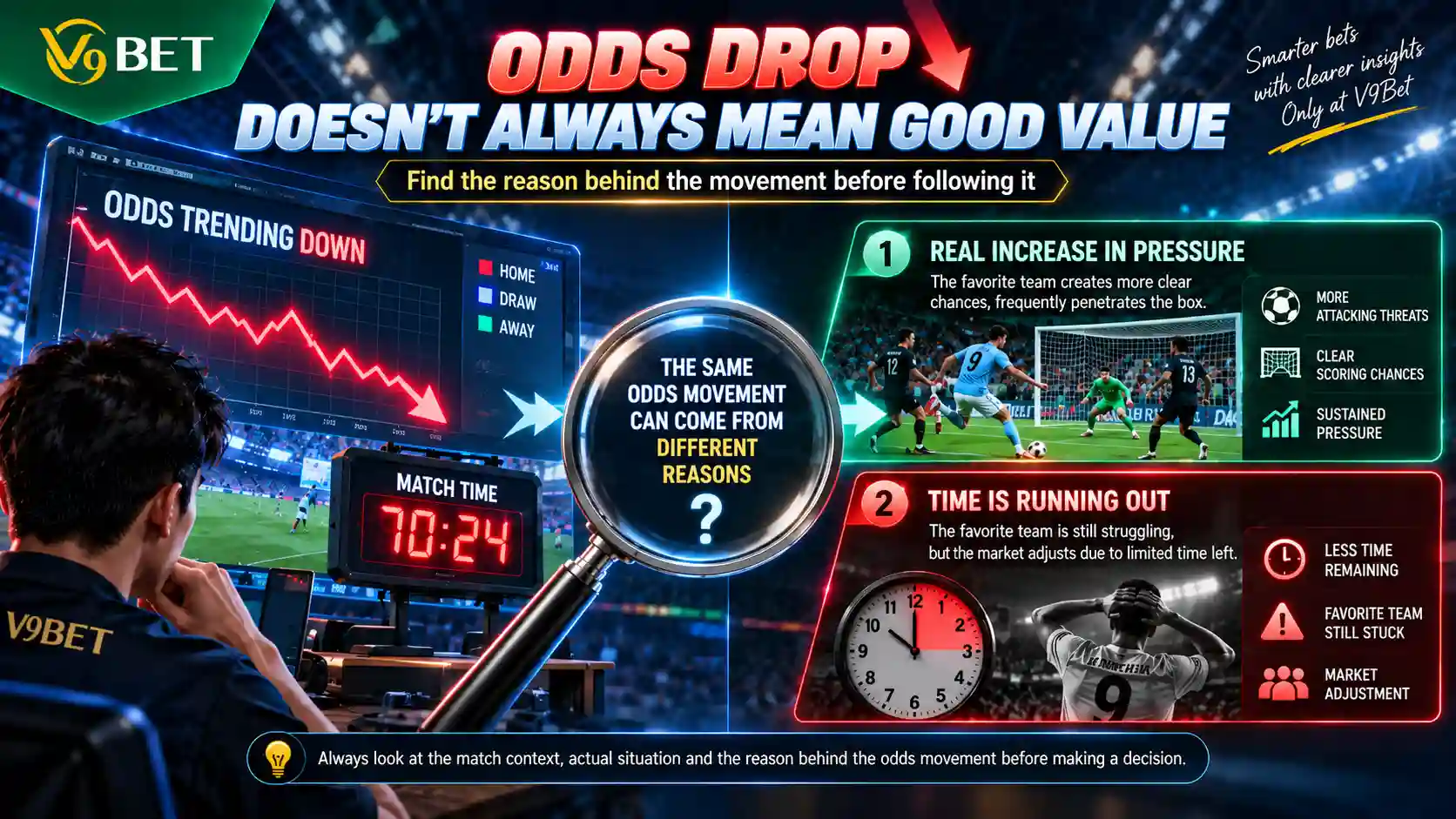
Odds movements are the result of time, scoreline, match events and market reactions. They are not an independent prediction signal. The same handicap movement can have different meanings depending on which team is leading, how much time has passed and whether the pressure on the pitch has genuine substance.
When the match remains level, the handicap on the stronger side will often change gradually because the amount of time available to create a winning margin is becoming shorter. If a player sees a more “comfortable” handicap and assumes that the price has become attractive, they may overlook why the handicap has dropped: the stronger team has not yet found a way to unlock the match. A cheaper price is not automatically a valuable price.
The Over/Under market is also strongly affected by the clock. The total-goals line tends to adjust as time passes without a goal, but the speed of the adjustment does not always match the quality of the chances. If the match is open, both teams are regularly breaking through midfield and creating one-on-one situations, a lower Over line may deserve attention. If the match is fast only in terms of passing speed but there is little space inside the penalty areas, taking the Over simply because the line has fallen can become a bet based on hope.
A practical approach is to remember the line you observed earlier and then compare the movement with what has happened on the pitch since. Do not look only at the current snapshot. SABA users can also refer to how to read the SABA betting board and live odds movements, while still checking the actual market status and information displayed in the betting session.
|
Betting Board Movement |
Possible Reason |
Reasonable Response |
|
Stronger-side handicap decreases over time |
No goal has been scored and the chance of creating a margin is decreasing |
Check the quality of chances before assuming the new price is attractive |
|
Stronger-side price drops quickly after a series of attacks |
The market is reacting to the pressure |
Wait to see whether the pressure continues or was only a short spell |
|
Over/Under line falls while the match remains open |
The clock is moving faster than the rate at which chances are being created |
Compare the new line with clear chances, not just the shot count |
|
Over/Under remains high despite few shots |
The market may be pricing in the risk of an open game or a major event |
Do not speculate; observe team distances and their ability to transition |
|
Market temporarily suspended |
A dangerous situation may be developing or data may be updating |
Do not immediately switch to another market simply to place a bet |
How to read live Champions League odds and handicap movements
How Should You Choose a C1 Live Betting Lobby on SABA, BTi and IM?
The right lobby is the one where you can read the market you understand and operate calmly. Do not assume that SABA, BTi or IM is always better for every match, because the available markets, presentation, suspension status and prices can change over time. This article does not make claims about any specific feature unless it has been checked directly on the current product.
Instead of asking which lobby has the most betting markets, ask which interface helps you clearly see three things: the score and time, the current line and the status of your open bet. If you have to scroll through too many markets and constantly switch tabs, the likelihood of making decisions based on reflex increases. Someone who mainly plays handicap and Over/Under does not need an extremely dense betting board if that density makes it harder to track the price they just observed.
If you are deciding between different options, the article V9Bet sports lobby comparison: SABA, BTi and IM Sports provides a broader view of how to choose a lobby based on your usage style. For those considering two popular options for live betting, see also BTi vs SABA for live betting. Actual features and markets should still be confirmed when you log in.
Another common mistake is opening all three lobbies simultaneously to hunt for small price differences. This can make it harder to focus on the match, especially when odds are moving quickly or markets are temporarily suspended. Without a clear method for recording prices and managing open bets, sticking with one familiar lobby can be easier to control than watching three betting boards at once.
|
Lobby Selection Criteria |
Self-Check Question |
Practical Priority |
|
Visibility |
Can you clearly see the time, score and current line? |
Readable within a few seconds without confusing markets |
|
Familiar Markets |
Does it offer the type of market you have prepared to follow? |
Fewer markets you understand are better than many you only partially understand |
|
Bet Management |
Can you track your selections and the amount already used? |
Avoid duplicate bets or increasing the stake outside your plan |
|
Operating Rhythm |
Does the interface make you feel pressured to click quickly? |
Prioritise clarity over the feeling of speed |
|
Market Status |
Is the market open, suspended or recently updated? |
Confirm the status again before submitting the bet |
When Should You Enter a Live Bet and When Should You Wait?
There is no fixed minute that is always best for Champions League live betting. The timing of an entry should be connected to a tactical change or a mismatch between the match action and the current price. A very open match in the 20th minute can provide more useful information than a fragmented match in the 70th minute affected by substitutions, fouls and score management.
First 15 Minutes: Read the Intentions, Not Whether Your Prediction Is Right
The opening phase shows which team wants to control the match, the main attacking patterns and how both sides press. However, it is also the period most vulnerable to misleading signals because players still have plenty of energy, the tempo is high and some early attacks may come from enthusiasm rather than a sustainable tactical advantage.
If the stronger team pushes forward immediately, watch how the opposition handles the press and where the stronger side's defensive line sits when possession is lost. Waiting through two or three attacking cycles can provide more useful information than entering immediately after the first shot. The feeling of missing a price is less dangerous than committing money before you understand the pattern of the match.
From Minute 20 to Half-Time: The Match Rhythm Begins to Take Shape
This period can often help distinguish temporary pressure from sustained superiority. Both teams have already revealed their attacking patterns, the areas being targeted and how they react after losing possession. If the stronger side repeatedly creates overloads on the flank or space between the lines, the information you observe is more reliable than what was available during the opening minutes.
However, the scoreline and psychology of the match can also slow things down before half-time. A team satisfied with a draw may reduce the number of players involved in attacks, while the stronger side may avoid taking risks that could lead to turnovers. When the tempo clearly drops while the market continues pricing the match according to the earlier spell of pressure, following the Over or stronger side simply because “half-time is approaching” is not a sufficiently strong reason.
Start of the Second Half: Read the Adjustments Instead of Replaying the First Half
After the break, a team may change its pressing approach, reposition players or increase the tempo on one flank. The second half should be assessed as a new state. A team that was under pressure in the first half may no longer struggle if it adds another player to midfield; conversely, the stronger side may have more possession while becoming less direct.
The first five to ten minutes of the second half can be enough to identify tactical adjustments without waiting too long. If the new approach creates a genuine difference, you can then consider whether the current handicap or Over/Under price remains acceptable. Do not simply buy back the first-half narrative at a price that has already changed.
Late Match: More Space Does Not Always Mean Better Finishing
The final 15 minutes are attractive because the team needing a goal has to push its defensive line higher. More space can appear, corners may become more frequent and every counter-attack can feel decisive. However, fatigue increases, final passes can become less accurate and interruptions can become more frequent. A more open match does not necessarily produce a proportionally higher scoring efficiency.
If you are considering C1 live betting late in the match, also account for the amount of actual playing time remaining rather than looking only at the clock. The leading team may slow the tempo, hold the ball near the corner flag or accept tactical fouls. When the price already reflects the expectation of a late goal, passing on the market remains a valid decision.
|
Stage |
Information to Prioritise |
Why You May Want to Wait |
|
0–15 minutes |
Pressing approach, attacking direction and defensive positioning |
Early match momentum can be exaggerated |
|
16–35 minutes |
Ability to sustain pressure and quality of chances |
You need to distinguish genuine superiority from a short burst of momentum |
|
Late first half |
Need for a goal and signs of a slowing tempo |
Both teams may prioritise safety before the break |
|
Start of second half |
Tactical and personnel adjustments |
You should not simply carry over the first-half conclusion |
|
Final 15 minutes |
Space, fatigue and score management |
Prices often strongly reflect expectations of a late goal |
Choose the Market According to the Match Story, Not Because It Feels Easy to Win
Each market requires different evidence. A stronger team applying pressure may be relevant when monitoring the handicap, but that alone may not be enough to support an Over selection if the opposition is defending with many players and cannot counter-attack. The same match action may create a corner opportunity, but only if the ball is repeatedly being played toward the byline, crossed and blocked, or cleared behind the goal.
Asian Handicap Requires the Ability to Create a Margin
When following the stronger side, the question is not only whether they can score, but whether they can achieve the required margin within the remaining time. A team that is drawing may increase its probability of winning the match, but the live handicap may still be unattractive if its attacking approach depends too heavily on individual moments.
Conversely, following the underdog does not mean believing that they are the stronger team. The reasoning may instead be that their defensive structure remains stable, little time is left and the stronger side is being priced too aggressively. However, a red card or tactical change can completely invalidate the original reasoning. At that point, reassess the situation rather than holding onto the bet simply because you already had a previous view.
Over/Under Requires Chance-Creation Speed, Not Visual Speed
A match can move quickly while producing few clear chances if both teams repeatedly lose possession in the final third. Conversely, a match that appears slow can still be dangerous if every attack places a player in a good shooting position. When betting live on Over/Under, the number of times the ball enters dangerous areas and how the defence handles those situations can be more informative than the total number of passes or the noise from the crowd.
The Under line should also not be selected simply because the clock has been running for a long time. If the team that is behind brings on another striker, the two lines begin to stretch apart and the opposition still has a strong counter-attacking threat, the match structure can open up very quickly. Less time is an advantage for the Under, but it is not enough to eliminate the risk created by an unbalanced game.
Corners and Cards Need Their Own Signals
The corners market can be worth monitoring when the attacking team repeatedly reaches the byline, has crosses blocked or forces defenders to clear the ball behind. Possession around the centre of the pitch does not automatically create corners. If a team prefers short combinations and central shots, its pressure may be high without producing a corresponding increase in corners.
Cards are related to the intensity of challenges, transition spaces, the scoreline and how players respond when opponents beat them. You should not assume that a major Champions League fixture will automatically produce many cards. If both teams maintain their positions and rarely need to commit fouls to stop counter-attacks, the reputation of the fixture does not replace what is actually happening on the pitch.
Three Live Scenarios That Can Easily Mislead Players
The first scenario is familiar: the stronger side dominates possession in an impressive-looking way and repeatedly pushes its full-backs forward but cannot penetrate centrally. The player sees the handicap falling and assumes this is an opportunity to take the stronger side at a lower line. The problem is that the falling handicap may reflect exactly the same problem: the attack is struggling and time is running out. If the crosses are not finding their targets, there is not enough evidence to call the new price a bargain.
The second scenario is an early goal that makes the match appear certain to go Over. After the goal, the leading team drops deeper, reduces its pressing and prioritises controlling space. The trailing team may have more possession but still lack quality in the final pass. If you take the Over simply because there has already been an early goal, you are evaluating the event that just happened rather than the rhythm of the match after that event.
The third scenario occurs late in the match: the underdog produces several dangerous counter-attacks, the stronger side is forced to commit fouls and the match becomes fragmented. Seeing both teams create chances can make the match feel extremely open, but the actual amount of time the ball is in play may be low. A late-goal market can feel emotionally attractive, but every stoppage reduces the remaining time faster than expected.
To prepare better for the broader tournament context, readers can refer to Champions League 2026/27: fixtures and difficult matchups. A crowded schedule, league-phase position and the objectives of each match can influence how teams manage games, but pre-match information still needs to be updated according to what actually happens on the pitch.
Bankroll Management for Live Champions League Betting
Live bankroll management should be decided before the match begins because the speed and emotion of a live game can make limits easier to stretch. Players should determine the maximum amount allocated to the entire session, the number of live entries and the loss threshold at which they will stop. This is not a formula that guarantees an outcome; it simply prevents one incorrect assessment from turning into a series of uncontrolled decisions.
Suppose you allocate one million Vietnamese dong for the entire Champions League viewing session. Using most of that amount during the first spell of pressure can cause later decisions to be influenced by the bet already in progress. If the stronger side does not score, the player may feel tempted to add more because they believe their original assessment is “about to be proven right.” If the team then concedes, the pressure to recover the loss can become even greater. Dividing the limit into smaller units is not intended to encourage more bets, but to prevent each decision from disrupting the entire plan.
One useful principle is not to increase the stake simply because you have just lost. The stake should only change when the bankroll plan was changed before the session, not because of the result of the most recent bet. If you have exceeded the planned number of entries, close the betting board and continue watching the match. You do not have to act on every odds movement.
|
Plan Component |
How to Set the Limit |
Purpose |
|
Viewing-session bankroll |
A separate amount that does not come from essential living expenses |
Prevent match results from affecting essential finances |
|
Bankroll per match |
Only a portion of the viewing-session bankroll |
Avoid concentrating funds on high-profile matches |
|
Number of entries |
Determine it before kick-off |
Limit chasing every market movement |
|
Stop-loss threshold |
Stop when the predetermined level is reached |
Prevent attempts to chase losses |
|
Post-win stopping threshold |
Do not increase betting because of excitement |
Protect discipline after a favourable result |
Mistakes That Can Make Live Betting Experience Ineffective
The biggest mistake is making a decision first and then searching for data to defend it. Once a player prefers the stronger side, they may treat every corner as evidence that a goal is coming while ignoring the opponent's counter-attacks. The solution is straightforward: before placing a bet, identify one signal that could make you abandon the selection. If you cannot identify any evidence that could contradict your view, there is a good chance you are simply defending an emotional decision.
Another mistake is using too many statistics without understanding how they relate to one another. Shots, possession, corners and dangerous attacks do not carry equal weight in every match. A close-range shot saved by the goalkeeper may be more meaningful than five long-range attempts. Data should help confirm what you see, rather than completely replacing the assessment of space and structure.
Players also frequently switch markets after their initial selection becomes suspended. They may want to follow the Over market, but when it is temporarily suspended, they switch to corners or handicap simply because they do not want to miss the match momentum. This is risky because the reasoning behind the original market may not apply to the new market. A suspended market is a signal to wait, not an invitation to search for another selection.
Finally, do not confuse correctly predicting the match with winning a bet. You may correctly predict that the stronger side will apply pressure, or even correctly predict that it will win, while still losing the handicap because the winning margin is insufficient. You may correctly predict that the match will become open late on, but the Over line may already be priced above what the situation justifies. Live betting is about assessing the price of a scenario, not simply predicting which scenario will occur.
A Short Process Before Confirming a Live Bet
Before selecting a side, pause long enough to answer five questions: Who does the current scoreline favour? How is the team you are considering creating danger? Has the opposition defence lost its structure? What does the current line require for the selection to win? And if the bet loses, will the remaining bankroll make you want to chase the loss immediately? These five questions take less time than dealing with a bet placed emotionally.
Then check that you have the correct match, correct market, correct selection and correct stake. With live betting, the price can update between the moment you observe it and the moment you confirm the bet. If the new price no longer fits the original reasoning, cancelling the action is a complete decision in itself. You do not need to place a bet simply because you have already spent several minutes analysing the match.
Finally, record the reason for entering the market in one short sentence. For example: “The stronger side is repeatedly entering the half-spaces, the opposition is losing second balls, and the current handicap remains within the predetermined limit.” If the reasoning is only “it feels like a goal is coming,” “this team is stronger,” or “the odds are dropping,” the available information is not clear enough to justify the stake.
Frequently Asked Questions About V9Bet Champions League Live Betting
Should I Wait 10–15 Minutes Before Entering a Champions League Live Bet?
Waiting 10–15 minutes can help identify the initial intentions and structure of the teams, but it is not a mandatory rule. Some matches require longer for spaces to appear, while others change immediately after a goal or red card. The purpose of waiting is to collect enough information, not to choose a fixed minute at which to bet.
Is SABA, BTi or IM Better for C1 Live Betting?
There is no single lobby that suits every player and every match. Prioritise the one where you can clearly read the time, score and familiar markets and manage your open bets effectively. The available markets and product status should be checked directly at the time of use rather than relying entirely on older descriptions.
Does a Falling Price Mean That Selection Is About to Win?
No. A falling price indicates that the market is repricing probability and risk, but the reason can come from match events, the passage of time or market activity. The movement should be compared with the quality of the chances and the scoreline context before treating it as an actionable signal.
Should I Follow the Over When One Team Is Applying Constant Pressure?
Pressure alone is not enough. The Over requires quality chances, the ability to transition between phases and sufficient time remaining. If the attacking team mainly passes sideways, crosses from deep positions or shoots from tight angles, the pressure may not translate into as many goals as expected.
Should I Place Another Bet When My First Live Bet Is Losing?
Do not increase the stake simply to recover a losing bet. Only consider another decision if it remains within the predetermined number of entries and total bankroll, and if it is supported by an independent reason. If the second decision exists mainly because you want to recover the loss, stopping is the more controlled response.
When Is It Reasonable to Skip a Live Bet?
Consider skipping the bet when the match action and price contradict each other, the market is changing too quickly, you cannot clearly identify the conditions required for the selection to win, or the stake would exceed your plan. An exciting match to watch is not necessarily a match with a price that suits your betting approach.
Expert Conclusion
Effective V9Bet Champions League live betting begins by reading the match before reading the price. Possession, shot counts and sequences of corners only become meaningful when placed within the specific structure of the game: where the ball is appearing, whether the defence is being pulled out of shape, how chances are being created and whether the team applying pressure can control the opponent's counter-attacks.
SABA, BTi and IM are options for accessing the markets, not replacements for a method. Players should use the lobby that helps them observe clearly, follow the correct market and maintain a disciplined decision-making rhythm. Do not open additional options simply because you are afraid of missing a small price movement.
The most important factor remains the price. Correctly predicting which team will win does not necessarily create a good handicap bet; correctly predicting that a match will open up does not necessarily mean the current Over line is worth taking. When the match action, price and bankroll plan are not aligned, waiting or passing on the market is not a lack of confidence. It is one of the practical challenges of live Champions League betting.